
Engines, systems and internal tools are already part of daily development.
Project status
Development
The core of the project is already built.
Totana 1578 is in an advanced stage of technical development. The fundamental systems that support the experience are already implemented, integrated and being used inside the game itself.
Funding will make it possible to complete the final artistic and sound production, as well as the remaining missions and pending content.
At this stage we are completing the script of the book that provides the narrative foundation and converting it into the game’s own playable structure.
Current project status
Many of the challenges are designed, implemented and tested.
The remaining work includes adapting the script for play, completing content, final art, sound, voices, integration and testing.
The book script is being completed and transformed into playable situations, decisions, documents, characters and missions.
Visual production in progress
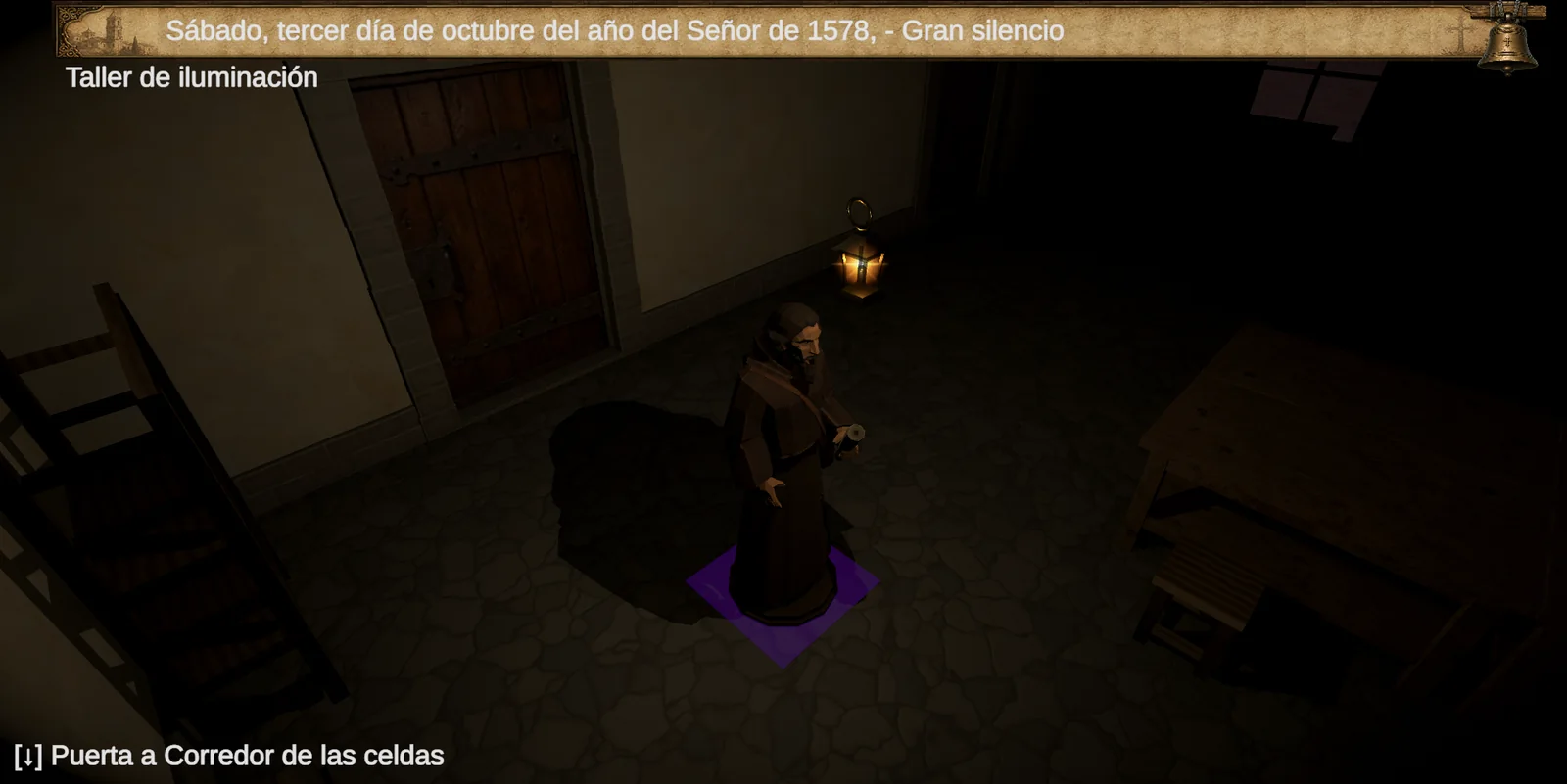
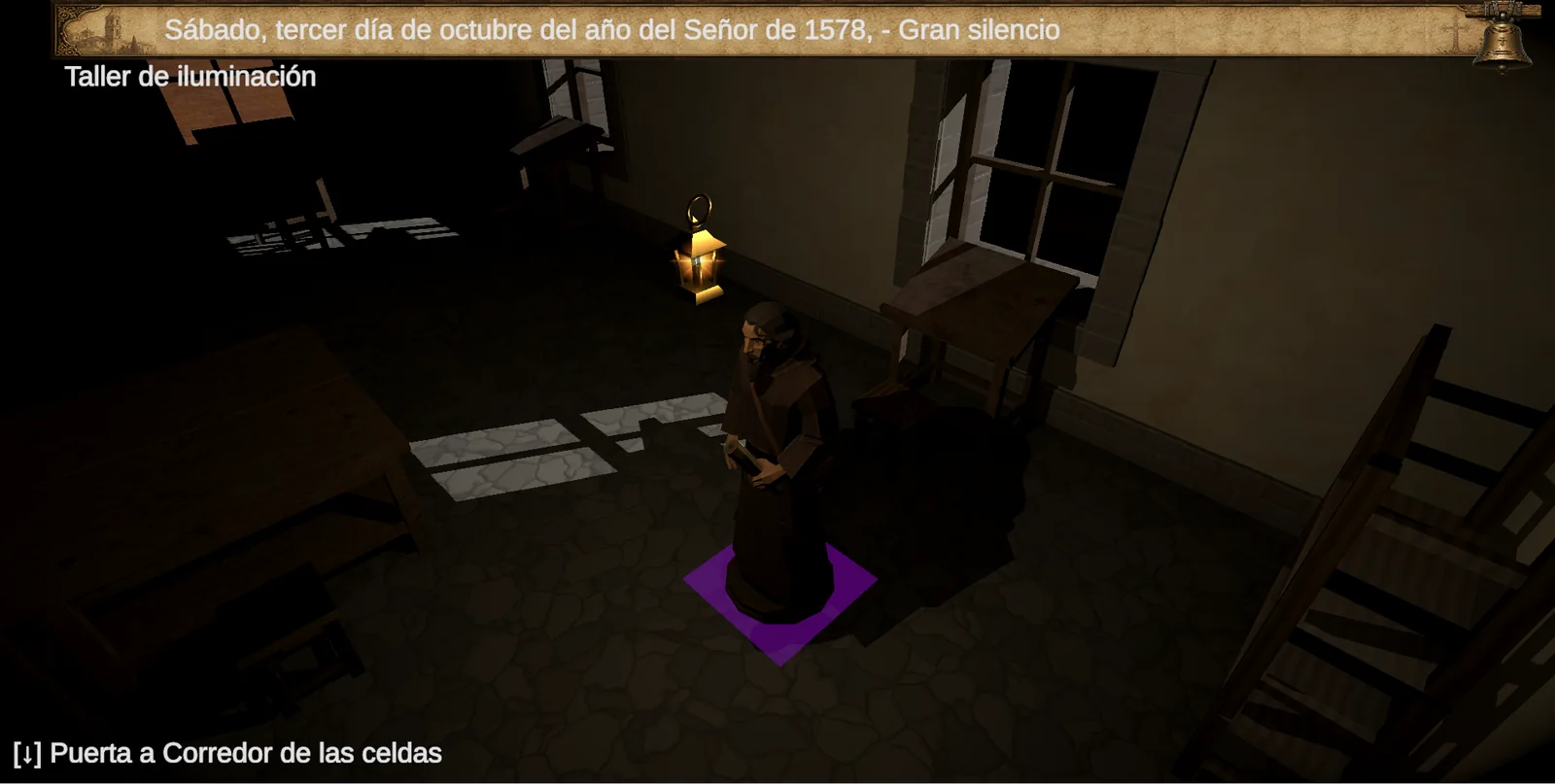
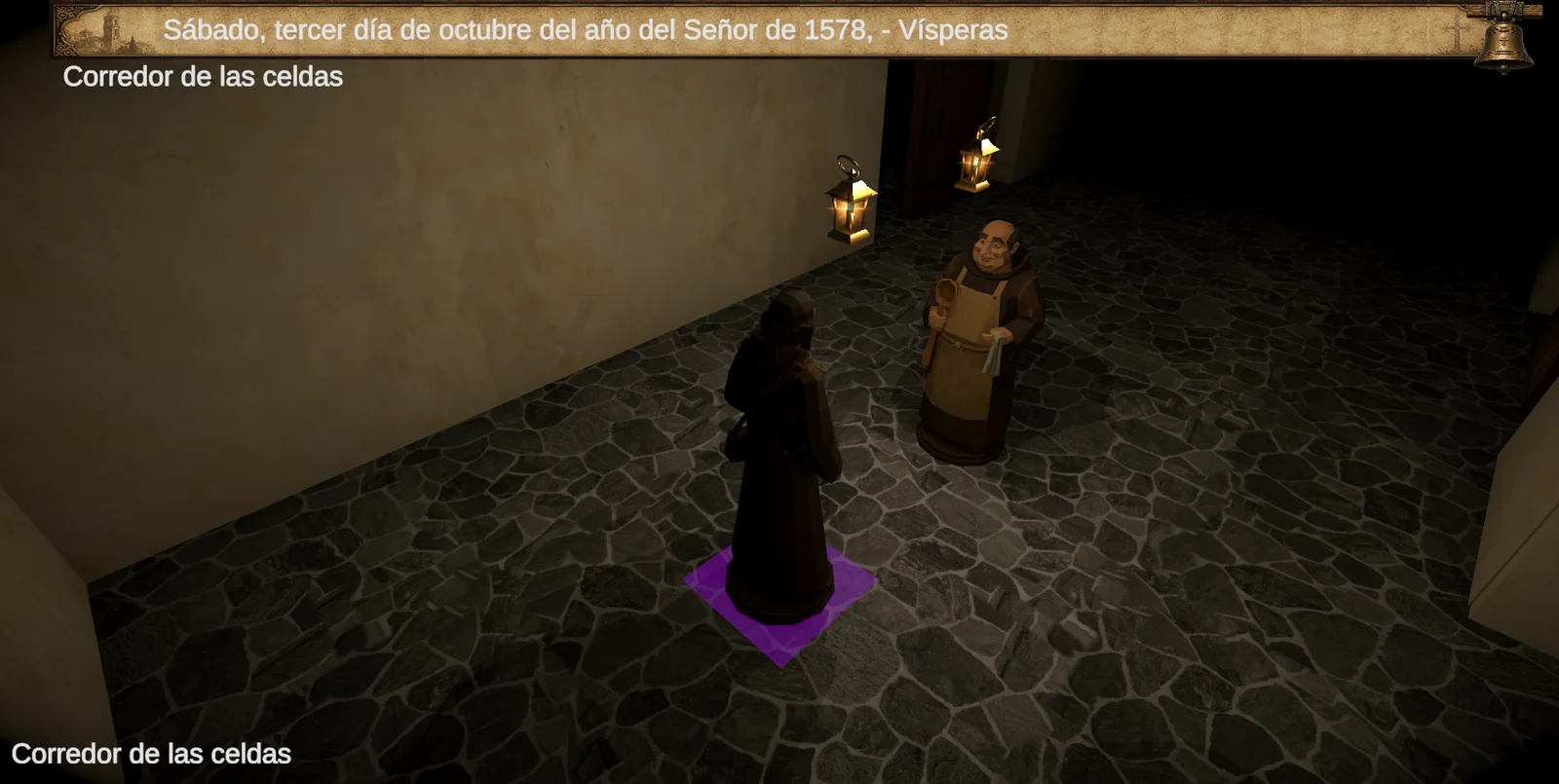
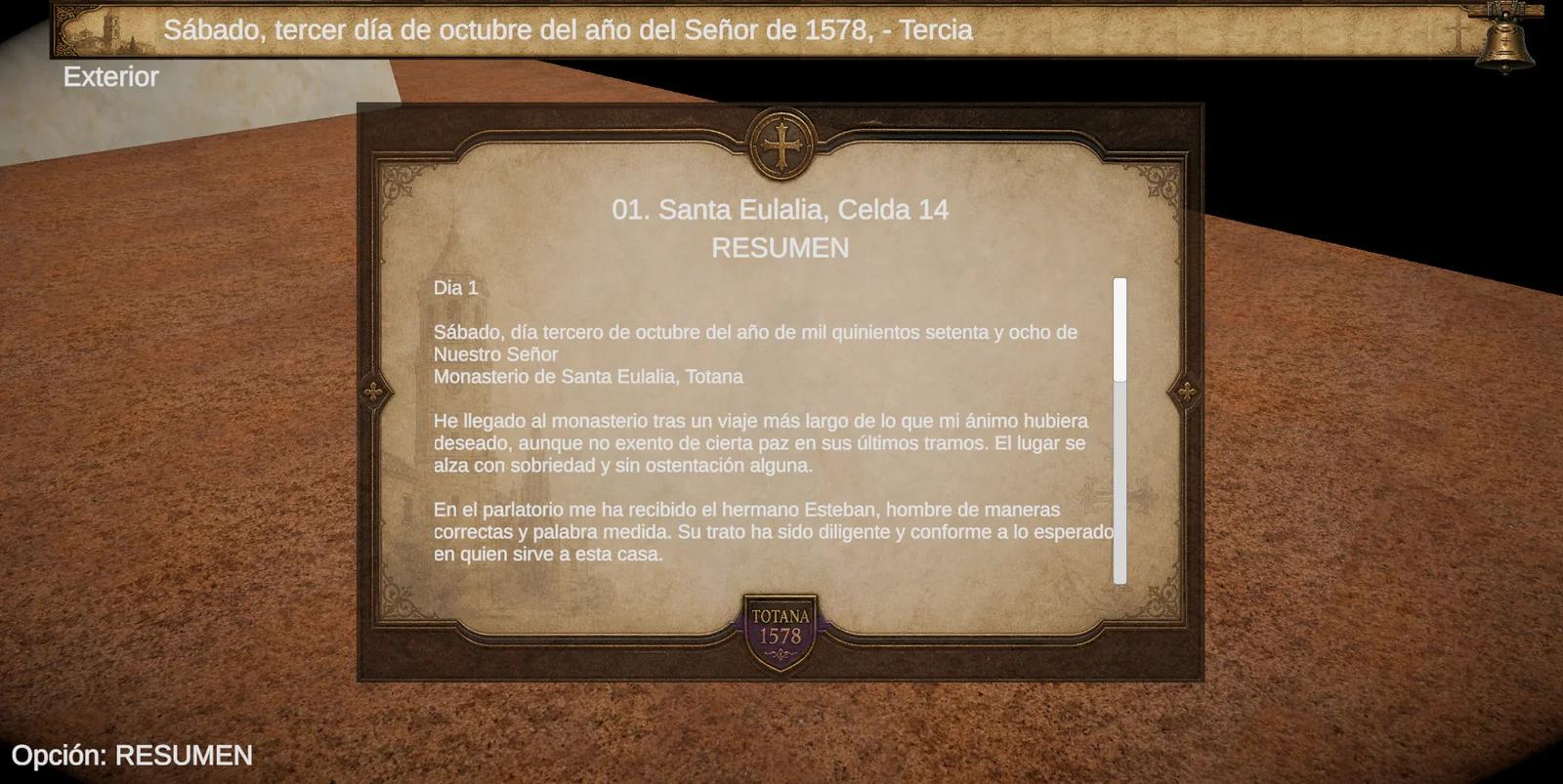
The monastery takes shape
These images come directly from the current game build and show environments, characters, lighting and interfaces already integrated into the project. They represent work in progress and may evolve before the final version.
Visual narrative
From comic art to animatic
Some events in Totana 1578 will be told through illustrated narrative sequences integrated into the videogame. They are not consecutive pages from a conventional comic: each composition condenses a specific scene and selects its essential visual moments.
Production process
- Interpreting the sceneThe script is examined to identify the actions, reactions and changes of situation that must be understood visually.
- Building the pageComposition, framing, rhythm and the relationship between characters, environments and objects are established. Translatable dialogue is not embedded in the artwork.
- Preparing the animaticPanels, planes and principal elements are organised to define their order of appearance, reframing, movement and points of attention.
- Sound synchronisationThe sequence is timed to voices, effects, ambience and music so that image and sound construct the event together.
- Accessible integrationThe visual presentation and sound sequence convey the same narrative event, allowing the story progression to be shared and the artwork to be reused across languages.
Sample animatic
This test shows how an illustrated page can be transformed into an audiovisual sequence. The camera moves through Cormac’s family, the inn where he grew up, the travellers and the stories that awakened his curiosity and eventually led him to investigate their origins.
Demonstration version without narration. In the final edit, framing and movement will be synchronised with voices, ambience, effects and music.
Implemented technology
Movement and exploration
Movement, interaction and navigation engine operating inside the monastery.
Object system
Management of interactive objects, states, actions and consequences integrated into the investigation.
Persistence and states
Progress preservation, player evolution and permanent changes in the game world.
Localization
Complete infrastructure for Spanish and English, integrated from the initial development stage.
Contextual audio
Ambient and spatial sound linked to events, spaces and narrative states.
VCS 6.0 integrated
Totana 1578 uses VCS —Vis Caeca Soni— in its advanced 6.0 version, with improved orientation management for the isometric environment of the game.
Mission engine
The heart of the experience.
The whole adventure is structured through missions, tasks and objectives that allow the player to obtain clues, documents and information in order to advance the investigation.
Objectives and tasks
Exploring rooms, finding objects, solving enigmas or helping other monastery inhabitants forms part of the main progression.
Requirements and conditions
Actions may depend on previous events, player states or discoveries made during the investigation.
Dynamic consequences
Completed decisions and objectives unlock new narrative lines, documents and deduction opportunities.
Minigames, puzzles and riddles
Many of the minigames, puzzles, riddles and logic challenges that form the experience have already been designed, implemented and tested.
Their mechanics and integration with the mission system are finished and actively used during development.
They are currently waiting for the final artistic and sound production: 3D models, 2D illustrations, music, effects and professional voices.
Narrative minigames
Integrated into the investigation and linked to mission progression.
Historical riddles
Inspired by documents, symbols and events connected with monastic life in the 16th century.
Deductive puzzles
Designed to connect information and build coherent hypotheses about the investigated events.
Internal development tools
Development uses custom tools created specifically to build content without depending on constant changes to the main game code.
Mission editor
Creation and validation of objectives, actions, requirements and consequences.
Object catalog
Centralized management of interactive elements and their behaviours.
Localization system
Simultaneous support for Spanish and English from the initial design.
Production tools
Validators, internal utilities and auxiliary systems to accelerate narrative and technical development.
What remains to be completed
Art production
- Final 3D modelling.
- Final textures and materials.
- Illustrations and 2D elements.
- Final visual interfaces.
- Final animations and effects.
Sound production and content
- Original music.
- Voices and narration.
- Final ambient sound.
- Completion of the last missions.
- Balancing and final testing.
Funding will make it possible to complete final production of a project whose technical and functional foundation is already operational, while the narrative and its playable adaptation continue towards completion.
The goal is not to start development, but to complete a work that can already be played, tested and evolved on solid foundations.